
If you live with ADHD, you already know that cleaning isn’t as simple as “just do it.” For many adults, the state of the home feels tied to shame, frustration, or the belief that everyone else seems to manage housekeeping effortlessly. But the truth is: your brain isn’t broken—your cleaning system is.
ADHD affects several executive function skills required for maintaining a home:
- Task initiation (getting started feels physically impossible)
- Working memory (you forget what you were doing mid-way through a chore)
- Sequencing (you don’t know which step comes first)
- Time blindness (a “quick clean” becomes a three-hour project)
- Sensory overload (visual clutter feels like static buzzing in your brain)
When you combine all of these, even basic housekeeping can feel like a mountain. This is why traditional cleaning advice often fails—they assume linear thinking, sustained attention, and low sensory input.
An ADHD cleaning system works with your brain’s wiring, not against it. And once you learn how to structure cleaning using ADHD-friendly approaches, you’ll begin to feel more in control of your space—even on the hard days.
What Makes an ADHD Cleaning System Different?
A system designed for neurotypical brains relies heavily on consistency, long-term planning, and internal motivation. But an ADHD cleaning system must function differently. It has to be:
- Frustration-proof (easy to start, easy to stop, easy to restart)
- Overwhelm-proof (reduces decisions instead of adding more)
- Sensory-aware (acknowledges and accommodates sensory overload at home)
- Flexible (works even when your energy or focus changes from day to day)
- Visually simple (because visual clutter = mental clutter for ADHD brains)
Most importantly, ADHD-friendly cleaning systems remove the feeling of “I don’t know where to start.” They give you a clear entry point, predictable rhythm, and micro-steps you can follow even when motivation is low.
This is why the methods below focus on choice reduction, environmental cues, and building momentum—not perfection. Your goal is not to become a spotless house robot. Your goal is to feel calmer, supported, and more capable in your home.
The Step-by-Step ADHD Cleaning System
This ADHD cleaning system method breaks the home reset into simple, achievable steps that lower executive function demands and reduce overwhelm.
Step 1 — Start With a 5-Minute Reset
Before you try to tackle an entire room, begin with a short burst. Set a timer for five minutes and focus only on removing obvious obstacles: trash, dishes, laundry, items on the floor.
This instantly reduces visual clutter and helps your brain shift into “cleaning mode.”
Why it works for ADHD:
- Lowers task initiation friction
- Offers a quick dopamine win
- Shrinks the perceived size of the problem
This step alone often transforms the emotional tone of the task.
Step 2 — Choose One Zone (Not a Room)
“Clean the kitchen” is too vague for an ADHD brain. Instead, break the home into zones—small, contained areas such as:
- Kitchen counter
- Bathroom sink
- One corner of the living room
- The table hotspot
- A single dresser top
Choosing a zone prevents working memory overload and keeps your step-by-step home reset from spiraling into chaos-cleaning.
Step 3 — Switch to Micro-Tasks
Once you pick a zone, break it into micro-steps like:
- Pick up all cups
- Put away anything that already has a home
- Wipe the surface
- Create a “temporary home” for items without one
Micro-steps are the backbone of any effective ADHD cleaning routine. They transform a fuzzy task (“clean this mess”) into something concrete, finishable, and far less overwhelming.
Step 4 — The Sensory Reset (Your Secret Weapon Against Overwhelm)
One of the most overlooked parts of ADHD-friendly cleaning is sensory management. When your environment is loud, bright, smelly, cluttered, or chaotic, your brain goes into defense mode. This is why many ADHD adults experience instant shutdown before cleaning even begins.
A quick sensory reset helps calm your nervous system so your brain has the capacity to focus.
Try one or more of these:
- Open a window for fresh air
- Dim harsh lights or turn on softer lamps
- Put on noise-canceling headphones or calming background noise
- Wear gloves or a mask if textures or smells are triggering
- Clear a small visual field (even if it’s just one countertop)
This step doesn’t clean your home—it cleans up your internal state so you can continue the step-by-step home reset without sensory overload derailing you.
When your sensory environment feels safe, your executive function has room to breathe.
Step 5 — Create a Visible “Finish Line”
One of the biggest challenges in ADHD housekeeping is never knowing when a task is done. Without a clear visual cue, your brain keeps scanning for more, leading to:
- Task-switching
- Perfection traps
- Feeling like “I didn’t do enough”
- Losing momentum partway through
To avoid this, set a visible finish line for your ADHD cleaning system.
Some ADHD cleaning system options:
- A single clean counter
- A made bed
- An empty sink
- A cleared entryway
- A tidy island or table
You can also use before-and-after photos to reinforce progress (a known dopamine boost for ADHD brains). A “reset object”—like a plant, candle, or a basket—can mark the zone as done so your mind can move on.
This anchors your ADHD cleaning system success and helps your brain register completion, which is essential for building future motivation.
Step 6 — Set Your Future Self Up for Success
Once your space is reset, the final step is building micro-routines that make tomorrow easier. These are not rigid schedules; they’re tiny supports that lower friction for your future self.
ADHD-friendly routines should be:
- Short (2–5 minutes)
- Non-negotiable but flexible
- Cue-based, not time-based
- Linked to existing habits
Some examples:
- After coffee → wipe counter
- After dinner → everything into the sink (sorting later is fine)
- Before bed → 2-minute floor sweep
- After laundry → put clean clothes in one basket to fold later
- Coming home → drop keys in a “landing zone”
These micro-resets prevent small messes from compounding into overwhelm, making your ADHD cleaning routine feel lighter, more predictable, and more achievable.
This step ensures your home stays more manageable long-term, dramatically reducing the cycle of “clean → crash → chaos → shame → clean again.”
ADHD-Friendly Cleaning Tools That Make Everything Easier
One of the biggest mistakes people make when building an ADHD cleaning system is assuming they must rely solely on willpower. But ADHD thrives with external supports, shortcuts, and tools that reduce friction. The right tools can remove half the overwhelm before you even begin.
Here are ADHD cleaning system tools that work with your brain, not against it:
Visual + Organizational Supports
- Color-coded baskets for quick “sort later” sweeps
- Clear bins that reduce visual uncertainty
- Rolling utility cart for moving between zones
- Hooks instead of shelves (less precision = more success)
Sensory Support Tools
- Noise-canceling headphones or brown noise
- Masks + gloves for sensory-sensitive cleaning tasks
- Soft lighting or lamp-only cleaning to reduce visual overload at home
Motivation + Momentum Tools
- Timers for 2–5 minute resets
- Before/after snapshots for dopamine reinforcement
- Mini “zone markers” like a plant or candle to signal “this area is done”
Executive Function Tools
- Checklist cards
- Step-by-step home reset printable
- Daily micro-routine prompts
These small supports dramatically reduce the cognitive load required to clean, helping your ADHD cleaning system routine feel possible on even low-energy days.
RELATED: ADHD Cleaning Support
Troubleshooting the ADHD Cleaning System: What to Do When You’re Overwhelmed or Shut Down
Even with the best ADHD cleaning routine, there will be moments of shutdown, avoidance, or emotional dysregulation. That’s not a personal failure; it’s a nervous-system response.
Here’s what to do when you feel stuck:
1. Use the First Five Objects Rule
Pick up just five objects. That’s it.
This instantly lowers task initiation demands and restarts momentum.
2. Try the 60-Second Grounding Reset
Sit or stand still for one minute.
Take three deep breaths.
Let your brain come back online before re-engaging.
3. Reduce the Environment, Not the Expectation
If the clutter is visually loud, try:
- Cleaning with lights dimmed
- Wearing sunglasses
- Using a soft-light lamp instead of overhead lights
- Turning away from the mess until you’re ready
Reducing visual input reduces emotional overload, paving the way for a more successful ADHD cleaning system.
4. Use a Compassionate Reframe
ADHD brains respond better to supportive self-talk than shame-driven language.
Try:
- “I don’t have to clean everything—just something.”
- “Momentum matters more than how much I get done.”
- “Future me will appreciate even a 2-minute win.”
5. Default to the Simplest Step
If all else fails: remove trash first.
It gives the fastest visual payoff and resets overwhelm quickly.
This framework helps you navigate emotional and sensory overload so your ADHD cleaning system stays usable even during harder moments.
RELATED: Sensory-Friendly Home Setup Guide | Support for ADHD Cleaning Overwhelm
Long-Term ADHD Cleaning System Routines That Actually Work
Once your home is reset, the goal is to maintain progress using routines that align with ADHD energy patterns—not rigid schedules that collapse the first time life gets chaotic.
An effective ADHD cleaning routine should be built on rhythms, not detailed plans.
1. The Weekly Home Rhythm (Simple + Flexible)
- Monday: Clear surfaces
- Tuesday: Laundry reset
- Wednesday: Floors + quick sweep
- Thursday: Kitchen reset
- Friday: Bathrooms
- Weekend: 10-minute family reset or rest
This rhythm gives structure without rigidity, which is essential for ADHD brains.
2. Cue-Based Habits (Work Better Than Timed Habits)
With an ADHD cleaning system, attach actions to existing patterns instead of specific times:
- After brushing teeth → wipe bathroom sink
- After making coffee → clear one counter
- After dinner → put everything in the sink (sorting later is okay)
- Coming home → drop items in the landing zone
These effortless connections build stability without requiring constant motivation.
3. Micro-Maintenance / Macro-Wins
Tiny actions create big results over time:
- 2-minute clutter sweep
- 5-minute trash run
- Daily “sink reset” (not full dishes—just clearing the basin)
- Load laundry today, fold tomorrow
These small steps prevent mess from reaching the overwhelming threshold that triggers shutdown, strengthening your ADHD cleaning system.
4. The “Sunday Setup” (Optional, ADHD-Friendly Version)
A weekly soft reset:
- Refresh your zones
- Restock essentials
- Reset your anchor surface
- Glance at laundry + dishes
Think of it as a gentle closing ritual for the week, not a rigid commitment.
Why ADHD-Friendly Cleaning Systems Work (The Science Behind the Method)
Many ADHD adults blame themselves for struggling with cleaning, but the real issue is mismatch—traditional cleaning advice is built for neurotypical executive function skills. The ADHD cleaning system in this guide works because it is designed around how ADHD brains process information, energy, motivation, and sensory input.
This system works because it reduces:
- Task initiation friction (the hardest ADHD barrier)
- Working memory load (less to hold in your head at once)
- Decision fatigue (you always know the next tiny step)
- Sensory overload (one of the biggest triggers for shutdown)
- Perfection paralysis (you have a finish line—one zone, one reset area)
And it increases:
- Dopamine hits through visible wins
- Predictability through micro-routines
- Momentum via 5-minute resets
- Emotional regulation by lowering chaos and clutter
- Self-trust—you see tangible progress quickly
In other words, your success isn’t coming from “trying harder.”
It comes from using an ADHD-friendly cleaning routine engineered to support your brain’s actual needs.
This is a compassionate systems-based approach—not a willpower-based one. That’s why it creates sustainable change instead of another stop-start cycle of cleaning and burnout.
Bringing It All Together: Your ADHD Home Reset Routine
You now have all the elements of a step-by-step home reset built specifically for ADHD:
- A 5-minute entry point
- Sensory grounding
- Zone-based cleaning
- Micro-tasks
- Visible finish lines
- Future-you routines
- Tools that reduce overwhelm
- Troubleshooting strategies for shutdown
When these components work together, your home becomes easier to maintain without feeling like a constant battle.
Here’s what this might look like on a real day:
- You walk into a messy room and feel overwhelmed.
- You start with a 5-minute reset—suddenly the room feels less chaotic.
- You pick one zone, not the whole room.
- You break it into micro-tasks—trash, dishes, wipe, reset.
- You anchor the finished area with a plant or candle.
- You stop. You’re done.
- You celebrate the win (your brain needs that dopamine!).
- Later that night, you wipe the same counter for 10 seconds as your micro-maintenance routine.
That’s it.
That’s how a chaotic home becomes an ADHD-friendly environment—not through deep cleaning marathons, but through a gentle, intelligent ADHD cleaning system.
Your brain is not the problem.
Your old system was.
Now you have a new one.
Download the ADHD Cleaning System Home Reset Checklist
If your home feels overwhelming, this step-by-step reset guide helps you create calm, order, and momentum—without burnout.
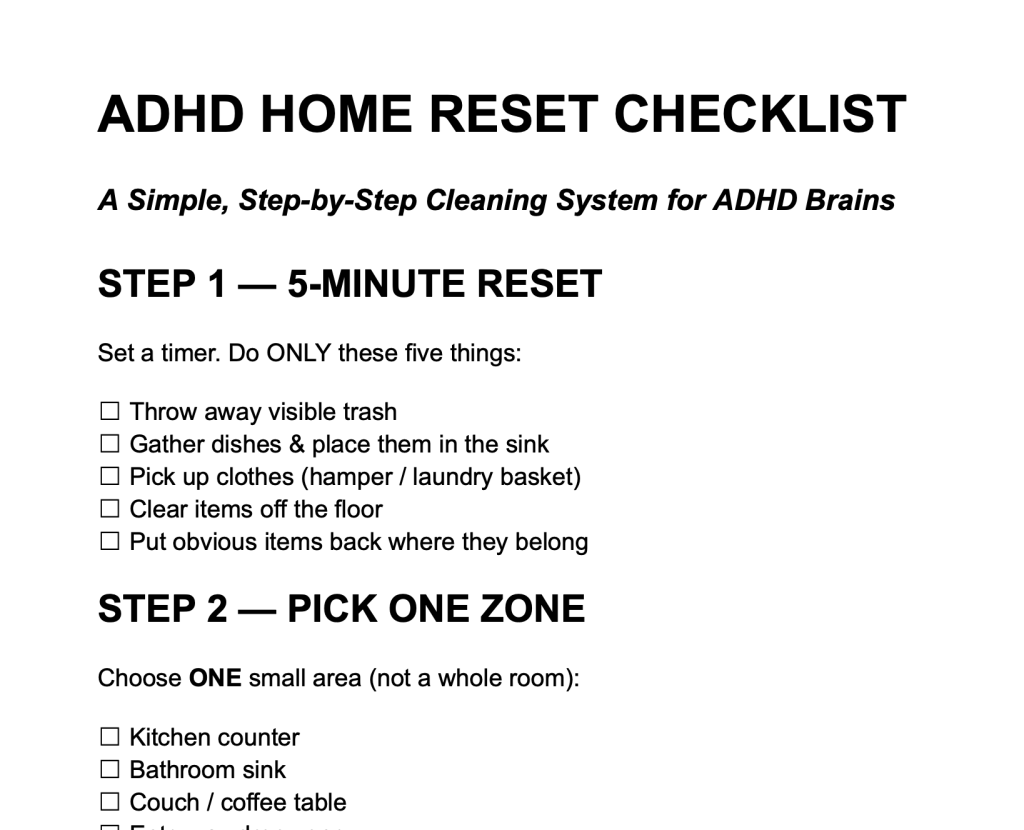
Click download the free ADHD Cleaning System Home Reset Checklist (PDF)
and start making your space feel manageable again.
 Neurodivergent Home Systems
Leave a comment