A messy home hits differently when you’re neurodivergent and don’t have an ADHD house cleaning checklist. What looks like “a quick tidy-up” to someone else can feel like walking into a wall of noise, decisions, and overwhelm. When your executive function starts to shut down, even figuring out where to start becomes its own impossible task. That’s why traditional cleaning checklists rarely work—they assume linear thinking, consistent focus, and the ability to move from one task to the next without getting derailed.
This post introduces a step-by-step ADHD house cleaning checklist designed specifically for neurodivergent brains. Instead of giant tasks like “clean the kitchen,” this ADHD-friendly cleaning method breaks everything into micro-steps, sensory resets, and tiny wins that build momentum. You’ll also find a free printable ADHD Home Reset Checklist PDF that turns this system into an easy, repeatable routine you can use anytime your home feels overwhelming.
If you’ve ever wondered why cleaning with ADHD feels so hard—and wished for a cleaning system built for the way your brain works—you’re in the right place.
Why Cleaning Is Hard With ADHD (It’s Not Laziness — It’s Executive Function)
Cleaning isn’t a character issue. It’s a brain issue—and an environment issue. ADHD impacts several executive function skills that make cleaning tasks feel much bigger than they really are. Understanding these challenges is the first step toward using an ADHD house cleaning checklist system that finally feels doable.
Working Memory Overload
When your working memory is overloaded, you lose track of what you were doing moments ago. You might carry a single cup to the sink and suddenly find yourself reorganizing a drawer or scrolling your phone. A conventional cleaning checklist expects you to hold the sequence of tasks in your mind—something that’s already stretched thin.
Task Initiation Difficulties
ADHD brains struggle with activation, meaning even simple steps like “pick up the clothes” can feel like climbing a hill. This is why an ADHD-friendly cleaning plan needs extremely small first steps: things you can do without negotiating with yourself.
Prioritization Challenges
Everything feels equally urgent—or equally overwhelming. That’s why you might stare at a messy room and freeze. A good ADHD house cleaning checklist tells you exactly where to start, removing the burden of decision-making.
Sensory Overload
Clutter, noise, lights, textures, and smells can overstimulate an ADHD nervous system. This leads to shutdown, frustration, or burnout mid-clean. That’s why any effective ADHD cleaning checklist must include sensory resets.
Emotional Dysregulation
Shame about the mess or fear of “never catching up” can trigger an emotional block. Cleaning becomes tied to fear rather than relief. A compassionate, structured cleaning method breaks this cycle so your brain can finally relax.
When you understand the invisible barriers, the need for an ADHD-friendly cleaning system becomes obvious—and empowering.
The ADHD House Cleaning Checklist (Free Printable PDF)
This section introduces the core of the post: the ADHD house cleaning checklist that guides you through a complete home reset without overwhelm. Instead of striving for perfection, this system focuses on momentum, clarity, and small wins. The printable version—the ADHD Home Reset Checklist (PDF)—turns this approach into a tool you can carry around your home.
Why This ADHD House Cleaning Checklist Works for ADHD Brains
This ADHD cleaning system is different from typical checklists because it is built on neurodivergent strengths and executive function support:
- Micro-tasks prevent working memory overload
- One-zone-at-a-time focus reduces decision fatigue
- Sensory resets help regulate before burnout hits
- Visible finish lines give your brain dopamine rewards
- Flexible routines meet you where you are
- Fast wins jumpstart motivation
- Optional weekly rhythms keep maintenance simple
Whether you’re cleaning with ADHD for the first time or rebuilding your executive function skills, this ADHD house cleaning checklist offers a realistic, compassionate path forward.
Download Your Printable ADHD Home Reset Checklist (PDF)
Use it anytime your space feels chaotic or impossible—this method brings everything back into manageable pieces.
Step-by-Step Breakdown of the ADHD House Cleaning Checklist System
The ADHD Home Reset Cleaning System works because it removes ambiguity, overwhelm, and decision-making. Instead of asking your brain to clean an entire room, this method breaks the process into simple steps that support executive function and reduce sensory overload. Below is the breakdown of the exact system included in your ADHD house cleaning checklist.
Step 1: The 5-Minute Reset (Instant Momentum)
This is your “activation energy” step — the minimum viable action that gets your brain unstuck. A 5-minute reset signals safety and manageability. You’re not “cleaning the house”; you’re simply clearing a path.
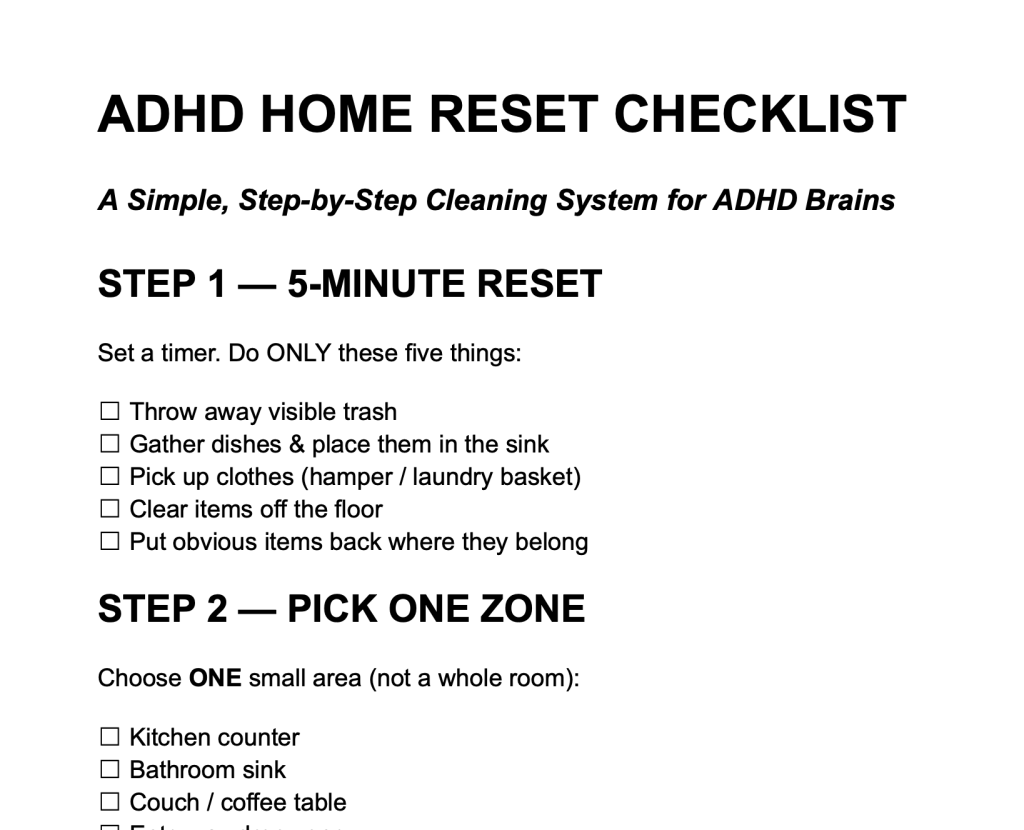
The checklist instructs you to:
- Throw away visible trash
- Gather dishes into the sink
- Pick up clothes
- Clear items off the floor
- Put obvious items back where they belong
These actions reduce visual clutter fast, which is essential for cleaning with ADHD because your brain can’t start organizing if the environment is already overstimulating. This step builds confidence without triggering perfectionism.
Step 2: Pick ONE Zone (Not a Whole Room)
Traditional cleaning lists often tell you to “clean the kitchen” or “clean the living room.” For an ADHD brain, this is too big, too vague, and too overwhelming. Instead, the ADHD cleaning system focuses on micro-zones:
Examples from the printable checklist:
- Kitchen counter
- Bathroom sink
- Couch or coffee table
- Desk surface
- Entryway drop zone
- Table hotspot
Choosing one zone gives your brain a clear container for effort. It’s not “clean the whole house,” it’s “reset the coffee table.” This shift is foundational to an ADHD-friendly cleaning routine because it reduces both decision fatigue and emotional overload.
Step 3: Break the Zone Into Micro-Tasks (The ADHD Superpower Step)
This is where the ADHD house cleaning checklist shines.
Instead of approaching a zone as one big job, you break it into tiny actions your brain can start immediately.
Examples of micro-tasks from the downloadable checklist:
- Pick up all cups
- Pick up all trash
- Gather dishes
- Put away items with a home
- Create a temporary bin for homeless items
- Wipe the surface
- Reset the space (plant, basket, candle)
Each item is intentionally simple. This is crucial for cleaning with ADHD because micro-tasks:
- Help bypass task initiation problems
- Prevent working memory overload
- Offer repeated dopamine hits
- Keep you from spiraling into “everything is a mess”
Micro-tasking transforms chaos into clear, actionable wins—and it’s the heart of every effective ADHD cleaning system.
Step 4: Sensory Reset (Regulate Your Nervous System Before Continuing)
One of the biggest unspoken challenges of cleaning with ADHD is sensory overwhelm. Visual clutter, noise, bright lights, textures, and even smells can send your nervous system into fight-or-flight—long before you finish your task.
That’s why the ADHD house cleaning checklist includes a built-in Sensory Reset step. Before moving deeper into your cleaning routine, you intentionally lower environmental stimulation to help your brain stay focused and regulated.
Examples from the checklist include:
- Opening a window for fresh air
- Dimming harsh lights or switching to softer lighting
- Putting on headphones or preferred background noise
- Wearing gloves or a mask for sensory insulation
- Taking three deep breaths
- Setting a calming scent
This is not optional—it’s a strategic pause.
A calm nervous system = better executive function.
By incorporating sensory care, this ADHD cleaning system ensures you don’t burn out before you finish your first zone. It’s not about pushing through discomfort; it’s about making cleaning feel safer and more tolerable for your neurodivergent brain.
Step 5: Set a Visible Finish Line (How ADHD Brains Know They’re Done)
ADHD brains love closure, but traditional cleaning rarely provides clear endpoints. You might clean a little here and there but still feel like nothing is actually finished. This is discouraging and makes it hard to build momentum.
The ADHD house cleaning checklist solves this with “visible finish lines”—signals that tell your brain: This zone is done.
Finish line options from the checklist include:
- Taking a before/after photo
- Clearing one anchor surface
- Placing a reset object like a candle, plant, or basket
- Stepping back and visually observing the difference
These cues create a strong dopamine reward loop. They help you recognize progress (which ADHD brains often miss), and they create a satisfying sense of completion—something that traditional cleaning methods overlook.
A visible finish line transforms your cleaning routine from an endless task into a meaningful achievement, reinforcing your new ADHD-friendly cleaning habits.
Step 6: Future-You Micro Routines (Sustainable Maintenance for ADHD)
Most cleaning systems fail because they require too much consistency, too much time, or too much working memory. But the ADHD cleaning system in this post uses micro-routines—tiny maintenance habits that take less than a minute and dramatically reduce future overwhelm.
The checklist includes micro-habits like:
- After coffee → wipe one counter
- After dinner → move all dishes to the sink (not washed, just moved)
- Before bed → 2-minute floor sweep
- After laundry → one-basket fold method
- Coming home → use the landing zone
These routines are intentionally small and flexible, making them sustainable even when your executive function is low.
Micro-routines prevent ADHD overwhelm by:
- Reducing visual clutter
- Lowering activation energy for cleaning
- Keeping messes from snowballing
- Creating predictable anchors in your day
This is what turns a one-time ADHD home reset into a manageable long-term system.
Quick Reset Tools for When You’re Overwhelmed
No matter how good your intentions are, there will be days when your brain shuts down and the house feels impossible. The ADHD house cleaning checklist includes a menu of fast “reset tools” designed for moments when executive function is extremely low.
These include:
- First 5 objects: Pick up only five things. Stop after that if you need to.
- 60-second grounding: Breathe + pause + reset your body.
- Remove trash only: A low-effort task with a big visual payoff.
- Do the easiest thing in the room: Momentum > perfection.
- Reduce sensory load: Lights down, headphones on.
- Step away briefly: Regulate before re-engaging.
These micro-interventions are crucial because they interrupt paralysis and help you regain control without forcing your nervous system into overdrive.
This is ADHD-friendly cleaning at its most compassionate and efficient.
Optional Weekly Home Rhythm (Flexible, Not Rigid)
Some people with ADHD benefit from having a gentle weekly structure—not a strict routine, but a rhythm that makes the week feel organized without pressure. The ADHD cleaning system includes a simple, optional weekly rhythm:
- Monday – Surfaces
- Tuesday – Laundry
- Wednesday – Floors
- Thursday – Kitchen
- Friday – Bathroom
- Weekend – 10-minute reset + rest
The goal is not perfection.
It’s predictability without rigidity.
If you skip days (and you will), the rhythm still helps reduce decision fatigue. It makes cleaning with ADHD feel more like a gentle cycle than a crisis response.
Download the ADHD House Cleaning Checklist (Free Printable PDF)
Cleaning doesn’t have to feel impossible. When you have ADHD, the right structure makes all the difference—and this ADHD house cleaning checklist was built specifically for neurodivergent brains.
Inside the printable, you’ll find:
✨ A step-by-step ADHD cleaning system
✨ Micro-tasks that prevent overwhelm
✨ Sensory reset strategies
✨ A one-zone-at-a-time method
✨ Quick reset tools for tough days
✨ Optional weekly rhythms
✨ Future-you micro-routines
Whether your home feels a little messy or completely out of control, this guide gives you a clear, gentle way to get started—without burnout or shame.
Click below to download the free ADHD House Cleaning Checklist (PDF)
and take your first small step toward a calmer, more manageable home.
Download the ADHD House Cleaning Checklist
Concluding Thoughts
A clean home isn’t about willpower, discipline, or finally “getting your life together.” When you live with ADHD, clutter and mess are symptoms of a brain that’s working incredibly hard just to navigate daily life. You’re not failing—your cleaning methods simply weren’t designed for the way your mind processes information, sensory input, and tasks.
The good news? You don’t need a perfect routine or an expensive system. You just need a structure that understands you.
The ADHD house cleaning checklist you explored today—paired with the downloadable ADHD Home Reset Checklist—gives your brain exactly that structure. With micro-steps, sensory supports, and clear finish lines, you can transform cleaning from something overwhelming into something achievable and even dopamine-friendly.
Start small.
Choose one zone.
Do one micro-task.
And let those tiny wins stack up.
Your home doesn’t need perfection—it needs compassion, clarity, and a method that matches the way your brain works. And you deserve a living space that feels supportive, not stressful.
Whenever you’re ready to reset your space, this ADHD-friendly cleaning system will be right there with you.
 Neurodivergent Home Systems
Leave a comment